
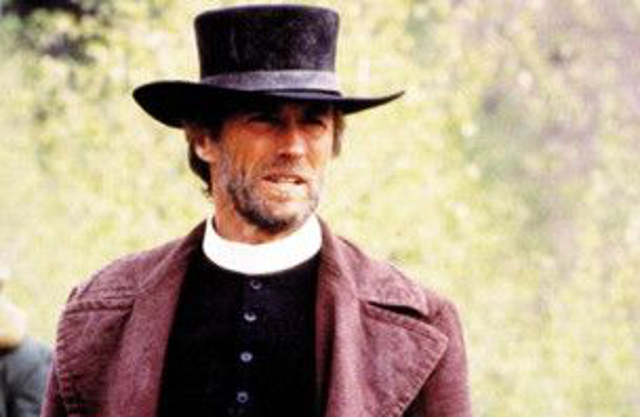
I’ve been a catholic layman since my grandma told me to attend “doctrina” as a child, so I have some understanding of the rituals and ceremonies of the Catholic church. So, thinking about it, I wonder what I would say to the parish if I became a priest and gave my homily for the first time. It’s kind of like being a new sheriff in town, so I guess it would go something like this…
“Thank you for the mighty fine welcome. Since this is my first homily, I need to clear up some things and lay down the law. This is a church building, meaning this is where the church, meaning YOU, meets to worship. In front of the church is the altar where we priest celebrate Mass, and by the altar is where the Blessed Sacrament is located. By this, it means that JESUS IS ALIVE in the Holy Eucharist, so act with reverence and don’t be playin’ around!
Now, when you come inside, be here with a Christian attitude. You’re coming to praise and worship the Lord Jesus as we celebrate the last supper with Him. It’s like a banquet where you come dressed in your Sunday best. If your best is a suit and tie, so be it. In other words, wear appropriate clothing. No t-shirts or blue jeans or girls wearing party dresses for night clubbing. Before you sit down in the pew, kneel or bow before the altar. You’re actually acknowledging His presence.
Pray before the Mass so you can be in the spirit. If you need to talk to somebody, do it outside or in the vestibule. If you need to greet people, that’s where you should do so. That’s why it was built. Once inside, your gabbing would be botherin’ people in prayer. And for you parishioners who come in late – for Pete’s sake, don’t go into the crying room. That’s where the parents are with babies who can’t stop crying. Hightail it out of there!
During the Mass, I expect everyone to follow the Mass with the Missalette. However, when the lector is reading the Word, I expect you to listen rather than checking to see if they make a mistake. There are prayers before, during and after the Mass. I expect everybody to pray together in one voice. The same with the choir. When they sing, it’s actually a prayer that you should also be singin’. That’s why we offer you a song book. If you can’t sing, hum along!
There’s a part of the Mass that you must take seriously. That’s the Apostles Creed, the Credo or the “I believe”. That is important because it’s the essence of our belief. It clearly states what the Catholic church believes. So, take it to heart. The part where it says to bow, do so in respect.
When receiving the Communion host, bow before His presence and receive the host in your hand or on your tongue. No sign of the cross, no kneeling. The same when receiving the blood of Christ. Don’t come down the aisle with your arms a-swinging or your hands in your pocket. This is a solemn occasion where you are receiving the Blessed Sacrament. Now make sure your conscious is clear and in the spirit. Confession before mass is good for your soul.
I expect the ushers to greet you and bid you welcome. They should stand in the rear of the church to assist any parishioner who is having problems. They will ask members of the parish if they would take the offering to the priest. Sometime later they will hand you a church bulletin. Make my day and read it. There are announcements of future activities that you need to be aware of.
Here in the church, we have ministers to assist me in the liturgy. We also have ministers to go visit the sick and homebound. Also, youth ministers. They are an extension of the church. If you have the calling to become one, please see me. We always need new people and new manpower. Join the Knights of Columbus. They are the ones I go to for projects that need to get done. We will always have need of the ladies to help with things that are required for preparation on special days of observance. Let’s be clear. All men and women are needed in every aspect of church activities!
After the Mass, be respectful and let me leave the altar before you make a mad dash for the door. If you must leave before the mass has ended, leave quietly. There are others still in prayer. You might wait until the choir finishes the closing hymn. Again, you should be singin’ or humming along.
Now, to end my homily… Jesus loves you! Amen”
 Gene's Corner